News and resources
Beyond Control: Re-imagining Philanthropy for True Emergence and Inclusion
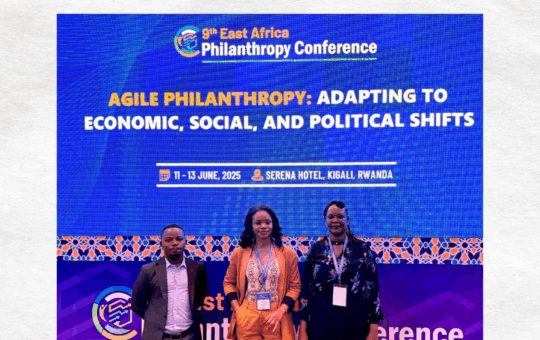
As a co-facilitator of one of the co-creation labs at the 9th East Africa Philanthropy Conference in Kigali, I asked participants:
What institutional habits make your organisation feel like a cage? What are the invisible rules, norms, or routines that limit emergence, creativity, or responsiveness in your team? What would your organisation, the sector look like, feel like, sound like in practice if it truly served emergence instead of control?
These questions set the tone for deep—sometimes uncomfortable—reflection, a process I shared with Joyce Nairuba from LABE Uganda, and Kasi Bismwa from the Expert Advisory Group, who joined me as co-delegates of the Moving Minds Alliance (MMA) at the conference.The MMA originally started as a donor collaborative, with a ‘Global North’ identity, but in the last 3 years is making conscious efforts to create more seats at the table for local experts and organisation; this is a journey in progress.
The conference opened with a provocative call by Brian Kagoro, Managing Director of Programs at the Open Society Foundation, who urged us to look beyond the simplistic narrative that our sector’s crisis is about funding shortages. Instead, he called us to confront models rooted in colonial support, racialized principles, and philosophical complacency.
Dismantling What No Longer Works
Throughout panels, workstreams, and co-creation labs, we explored how superficial fixes perpetuate the status quo. We discussed how philanthropic flows, when disconnected from the communities they intend to serve, can reinforce extraction rather than empowerment. The conversations also delved into trust as the essential currency of systems change and the architecture of sustainability. We acknowledged that survival and scale in uncertain times require innovative funding models—carbon credits, social enterprises, blended capital—but the sector’s greatest challenge is ideological: maintaining mission alignment and strategic discipline amidst monetization pressures.
Sustainability, we agreed, depends on governance and coherence—not just on resources.
Coherence, Readiness, and the Power of Local Leadership
Day two featured a compelling panel on Building Coherence in a Fragmented World. The discussion highlighted that while coordination enables joint action, true coherence demands shared meaning, ongoing interdependence, and relational trust. Institutions must evolve from program-building to ecosystem stewardship, embracing complexity and structural readiness rather than mere scale. Policy integration requires philanthropy to become an engaged governance actor, not an autonomous outsider, with legitimacy built through shared accountability and co-ownership.
Readiness—the ecosystem’s ability to sustain innovation—emerges from investing in infrastructure, relationships, and culture. Trust is best embedded in system design, not left to personal charisma. Ultimately, strategy success depends on creating conditions where disagreement strengthens collective coherence.
Reflections of MMA Delegates
Reflecting on his biggest takeaway from the conference, Kasi, shared:
“One of the most striking takeaways from the Conference was the call to resource local strengths—because true change begins within. For the Global South, reducing dependency on shrinking global North aid means recognising the immense value our communities already bring. As someone with lived experience of displacement, I felt seen when MMA made space for our voices—not just in conversation, but in leadership. When communities lead the change they want to see, we don’t just imagine liberation—we create it.”
Joyce, added:
“The Conference sparked not only deep reflection, but a call to action. We have immense power to amplify our impact—by equipping our teams with the tools of tomorrow, fostering a culture where philanthropy thrives from within, and honoring the often-invisible contributions of our communities. It’s not about putting our logos up front—it’s about showing up as true partners. We have the leverage to shape contracts that serve our stakeholders’ best interests. Let’s not just recognize that power—let’s use it.”
As a multistakeholder advocacy impact alliance, the MMA is committed to decolonising and dismantling discriminatory ideologies in its work by prioritising local leadership and expertise in our strategic planning and implementation. We actively create space for local voices through our Expert Advisory Group and strategy consultations. Our research and data collection efforts are led by local researchers, ensuring that our evidence base is contextually relevant. Additionally, we facilitate ongoing knowledge exchange between local and global stakeholders through webinars, highlighting local insights and innovations for broader impact, but there is still more to be done to ensure our governance and engagement mechanisms are truly inclusive and grounded in the needs of the communities we serve.
Reimagining Philanthropy: From Colonial Models to Community Power
The conference called for a fundamental reimagining of philanthropy—urging a shift from donor-centric, colonial models toward justice-driven, community-anchored approaches.
Participants highlighted the need for true resilience through structural introspection and inclusive infrastructure. Data practices should foster healing and community-defined impact. Impact measurement systems must reflect complexity and invite co-ownership, while financial innovation should prioritize power redistribution and be anchored in community needs.
Ultimately, the sector must summon the courage to challenge entrenched colonial legacies in governance, policy, and culture—placing trust, legitimacy, and community-defined success at the heart of future efforts.
Sanctioned Ignorance and the Challenge of Change
To me, these conversations echo all too familiarly—a refrain that lingers from my 2023 research on decolonising charity, where themes like “sanctioned ignorance” (Spivak,1999) surfaced as pervasive, often invisible barriers to true dialogue and innovation. Sanctioned ignorance isn’t just about individual resistance; it’s about systems and habits that subtly silence voices that don’t conform, stifling the emergence of new ideas and perspectives.
So I ask again:
What institutional habits, practices, and policies make your organisation feel like a cage? What invisible rules, norms, or routines are quietly limiting your team’s creativity and responsiveness? As individuals, organisations, and networks, we are a microcosm of the system. Recognising these patterns is the first step toward transformation—but naming them alone is not enough.
What’s Next? The Conversation Continues
That’s why, after the conference, the East Africa Philanthropy Conference (EAPN) is mobilising spaces and tools for ongoing reflection and change. The conversation didn’t stop at the conference. Watch this space!
By: Lola Ayanda