News and resources
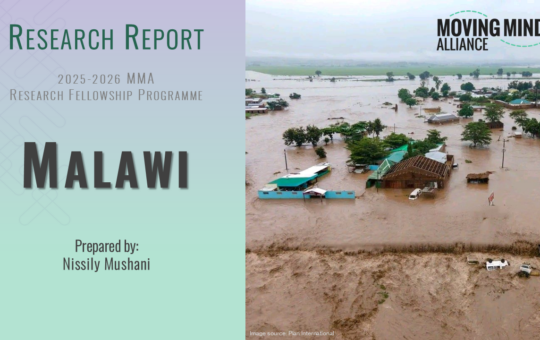
Research Report: Community-Led Approaches to Protecting Young Children During Cyclone Emergencies in Southern Malawi
Researcher: Nissily Mushani
Research Mentor: Tafadzwa Chevo & Moving Minds Alliance
This study examines how communities in cyclone-prone Southern Malawi protect young children before, during, and after cyclones, with a focus on intergenerational and traditional knowledge. Drawing on focus groups, interviews, and an adapted photovoice approach with children across Nsanje District, the research finds that informal caregiving networks — grandmothers, aunts, older siblings, and neighbours — form the primary protective infrastructure for young children, often operating independently of formal disaster risk reduction (DRR) systems. Communities rely on indigenous early-warning cues, passed down through stories and songs, though this knowledge is eroding as younger generations turn to mobile technology. Barriers include limited resources, weak infrastructure, and the near-total absence of male caregivers from preparedness activities. The study calls for a hybrid DRR model that formally recognises and resources community-led child protection mechanisms alongside national systems.
Keywords: cyclone emergencies; disaster risk reduction; indigenous knowledge; informal caregiving networks; community-based child protection; Malawi; early childhood development in emergencies