News and resources
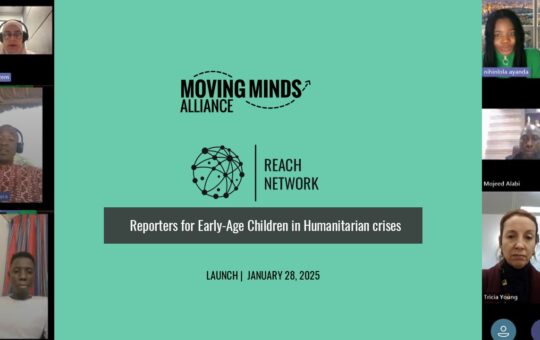
Enhancing Advocacy Through Journalism: Reporters for Early-Age Children in Humanitarian crises (REACH)
The global humanitarian crisis has reached unprecedented levels, affecting every region. According to the IRC 2025 Emergencies Watchlist, just 20 countries, home to only 11% of the global population, account for 82% of international humanitarian needs[1]. Children are disproportionately affected, making up over 40% of the displaced population and 50% of refugees, with nearly 20% of refugees being under 5 years old[2]. The media often controls the narrative, deciding which stories to highlight and which to overlook. Unfortunately, this means that some of the world’s worst displacement crises remain underreported and largely invisible to the public and decision makers.
The Moving Minds Alliance advocates that effective Early Childhood Development in Crisis (ECDiC) programs must be multi-sectoral, integrating stimulation, education, health, nutrition, and protection. This requires collaboration across all sectors and robust support for parents and caregivers. A designated budget, such as allocating 10% of the national education budget, is crucial. However, integrating ECD into sector efforts presents significant challenges due to competing activities, workload, capacity, and leadership issues. According to UNESCO, there is an estimated annual financing gap of approximately $97 billion between 2023 and 2030 to meet the SDG 4 targets in low- and middle-income countries [3][4].
The countries were determined based on the IRC 2025 Emergency Watchlist and the Norwegian Refugee Council’s neglected hotspots published in 2024. These include Sudan, Occupied Palestinian Territory, Democratic Republic of Congo, Myanmar, Syria, South Sudan, Lebanon, Burkina Faso, Haiti, Niger, Nigeria, Cameroon, Mali, Somalia, Afghanistan, Yemen, Ethiopia, Central African Republic, Chad, Israel, and other crisis contexts – Bangladesh, Kenya, Uganda, Senegal, Sierra Leone, Jordan, Nepal, India, Venezuela and Colombia.
The objectives of the REACH Network includes:
- Raising Awareness: Highlighting neglected humanitarian hotspots and the unique needs of young children and their caregivers in these contexts.
- Building Evidence: Corroborating research findings with journalistic investigations to create a strong body of evidence to enhance advocacy efforts.
- Advocating for Local Solutions: Promoting the scaling of local humanitarian solutions, inclusive policies, and increased resources for local actors in the ECDiC field.
MMA will collaborate with REACH as the group works to develop advocacy journalistic pieces focusing on mental health, education, the power of play, gender, disability, nutrition, protection, and responsive caregiving. The goal is to ensure that families caught up in crises can rebuild resilience and foster the well-being and development of their young children.
Speaking during the launch of the network on January 28, 2025, Eric Kawa, Capital Radio Sierra Leone said,
“I am deeply motivated to be part of the REACH Network. I began my career as a journalist, starting as a child broadcaster and advocate on the radio. Being here again and connecting with this platform means a lot to me. My recent documentary for CNN featured a young child who suffered from the impacts of the 2017 floods. This network reignites my passion for reporting on children’s issues”.
By shining a light on these critical issues, the REACH Network aspires not just to report but to become a catalyst for accountability and drive meaningful change for the youngest members of our societies in crisis.
For inquiries or collaboration with REACH Network, please email: comms@movingmindsalliance.org