News and resources
OPINION: The Most Formative Years in the Most Fragile Places
As the world marked the 75th anniversary of the Refugee Convention, the gap between what we know about child development and what the humanitarian system actually delivers for the youngest children has never been more stark.
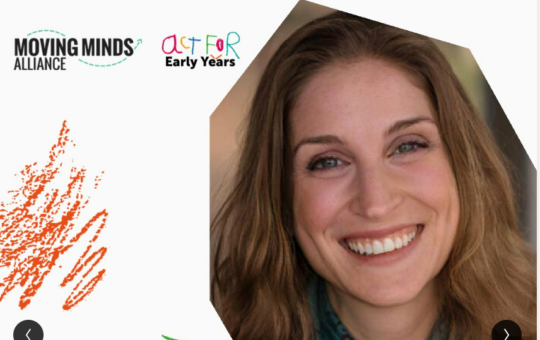
Katie Murphy, Interim Director and Co-Chair of Moving Minds Alliance, has spent more than two decades working at the intersection of displacement, caregiving, and early childhood development, engaging governments, NGOs, and communities across more than 20 countries. In this Q&A with TheirWorld, she reflects on what the numbers really mean for a developing child’s brain, what the international community consistently gets wrong, and why the sophistication of our response can never become a substitute for the political will to prevent displacement altogether.
Her conviction is clear: children don’t pause their development during a crisis, caregivers are the most powerful intervention we have, and investing in the earliest years is not simply a humanitarian act, it is an investment in the stability and peace of the world we all share.
1. Children make up 39% of all forcibly displaced people globally, despite being just 29% of the world’s population. What does that really mean for a child’s development in the earliest years of life?
The statistics tell an important story. First, many of today’s displacement crises are occurring in countries with very young populations. In Sudan, currently the world’s largest humanitarian crisis, roughly half the population is under the age of 18. Unfortunately, children in such contexts make up a large share of those affected by crisis and displacement.
Second, and I hear this time and again from refugees around the world, one of the primary reasons people flee is because of their children. Parents leave homes, livelihoods, communities, and everything familiar because they want their children to be safe, healthy, and have the chance for a better future.
But the numbers are particularly concerning when it comes to children’s development. Childhood is a relatively short window of time, and the earliest years are especially important for brain development. When 39% of displaced people are children, it means that a significant share of the world’s displacement crisis is unfolding during the most formative period of human development, when experiences are not only felt in the moment, but embedded in the body of the developing child.
For many children, displacement is not simply an event they experience. It is the longer-term environment in which they grow up. It shapes their relationships, their opportunities to learn, their sense of safety and belonging, and ultimately the trajectory of their lives. The experiences children have during these years help determine not only their own futures, but also the future of the communities they will one day lead and rebuild. In that sense, investing in young children affected by displacement is not only a humanitarian imperative. It is an investment in future stability and peace.
2. This year marks the 75th anniversary of the Refugee Convention. In your view, has thehumanitarian system’s response to the needs of the very youngest children improved meaningfully in that time, or are we still falling short?
Over the past 75 years, we’ve made remarkable progress in helping children survive crises. Advances in healthcare, nutrition, vaccination, water and sanitation, and humanitarian coordination have saved countless young lives. Child mortality has fallen dramatically worldwide, including in many fragile and crisis-affected settings.
But survival is only the beginning of the story. We’ve been much slower to recognize that young children need more than food, shelter and protection. They also need responsive caregiving, opportunities to learn and play, support for their mental health and wellbeing, and stable relationships with the adults around them. These are not luxuries to be addressed once a crisis is over. They are fundamental to healthy development.
This gap is reflected in how the world invests in crisis-affected contexts. Recent analysis released by the Moving Minds Alliance found that just 3.8% of international aid to crisis-affected countries supports all of the components of nurturing care for young children, and only about 0.5% supports early learning and responsive caregiving, which includes caregiver mental health.
While it is clear that we’ve made meaningful progress, we are still neglecting the core components that promote healthy development. The next chapter of humanitarian response must be about ensuring children not only survive crises, but have the opportunity to thrive through and beyond them.
3. You’ve worked across more than 20 countries. Is there something you’ve witnessed on the ground that you think the broader international community still hasn’t fully reckoned with when it comes to young displaced children?
I think we sometimes overlook or overcomplicate what young children need to thrive, even in the midst of crisis. When a child is suffering from malnutrition, disease, or injury, our attention is naturally drawn to those immediate and life-threatening needs. Those needs absolutely must be addressed. But a child is more than their immediate needs. Even in the most difficult circumstances, young children still need nurturing relationships, opportunities to learn and play, and caregivers who are supported and able to respond to their needs. The science on those fundamentals is remarkably consistent across cultures and contexts.
Where we often struggle is translating that knowledge into approaches that reflect local realities. Too often, we search for a single program or model that can be replicated everywhere. But what works for a displaced family in Sudan may look different from what works for a refugee family in Colombia, Bangladesh, or Lebanon.
The most effective solutions I’ve seen have combined strong evidence with deep local knowledge. They start by listening to families and communities and then adapting support in ways that are culturally relevant, feasible, and sustainable.
4. Early childhood is consistently underfunded in humanitarian response relative to what the evidence demands. If political leaders and donors commit to doing one thing differently for young displaced children, what should it be?
If political leaders and donors commit to doing one thing differently, it should be to make young children and their caregivers visible in crisis planning and response from the very beginning.
Too often, support for early childhood development, caregiver wellbeing, and early learning is treated as something that can wait until a crisis has stabilized. But childhood doesn’t wait. Children’s development continues every day, regardless of whether a conflict, disaster, or displacement crisis is unfolding around them. We need to move beyond treating these issues as optional add-ons and instead build them into humanitarian response plans, national policies, financing strategies, and preparedness efforts from the outset. That means ensuring that children’s developmental needs and caregivers’ perspectives are represented at decision-making tables, and that there are dedicated resources and accountability mechanisms to support them.
We cannot postpone childhood until stability returns. The most effective responses are those that protect children’s development while also addressing their immediate survival needs.
5. The case for investing in the earliest years, even in crisis settings, is well established. Where do you think that investment makes the biggest difference for a child’s long-term trajectory?
I think the biggest difference comes from strengthening the relationships around a child. Food, healthcare, protection, and education are all critically important. But what ultimately shapes a young child’s trajectory is the quality of the relationships they experience every day, particularly with parents, caregivers, and other trusted adults.
When we support caregivers, protect opportunities for play and learning, and create environments where children feel safe, loved, and able to explore the world around them, we’re doing much more than helping them cope with a crisis in the moment. We’re laying the foundation for future learning, health, resilience, and wellbeing.
What excites me most is that these investments often create benefits that extend far beyond the individual child. Children who are healthier, better able to learn, and more equipped to form positive relationships are more likely to contribute to stronger families, more cohesive communities, and more stable societies. That’s why I see investment in young children not only as a humanitarian intervention, but as a long-term investment in recovery, resilience, and peace.
6. You’ve spent your career working across governments, NGOs and communities in some of the world’s most complex settings. What is the international community most consistently getting wrong about young children in displacement, and what would it look like to get it right?
One of the things we most consistently get wrong is that we think about displacement primarily in terms of what families need, rather than what displacement does to the relationships that shape a young child’s development. For young children, displacement is not only the loss of a home or a place. It is often the disruption of the entire network of relationships that helps them feel safe, learn, develop, and make sense of the world around them.
When families are forced to flee conflict, violence, or disaster, children don’t just lose homes or possessions. They may lose daily contact with grandparents, neighbors, teachers, childcare providers, health workers, and other trusted adults who form their circle of care. Parents and caregivers are often navigating enormous stress, uncertainty, loss of livelihoods, legal barriers, documentation challenges, and concerns about their family’s future, all while trying to provide stability and hope for their children.
Yet our responses often treat children’s needs and caregivers’ needs separately. We may provide services for children without adequately supporting the adults who care for them. Or we may focus on helping caregivers access livelihoods, services, and opportunities without fully considering the young children who still need nurturing relationships, responsive care, and opportunities to learn and play.
Getting it right means recognizing that young children develop within relationships. It means designing responses that strengthen the entire circle of care around children and listening to the families and communities who are working every day to help children navigate displacement
But there is a harder truth beneath all of this. Even the most thoughtful humanitarian response is, at its core, a repair job, and no repair fully restores what displacement takes from a child’s earliest years. That window is narrow and unrepeatable. So, while we must get better at responding, we cannot let the sophistication of our responses become a substitute for the political will to prevent displacement altogether.
Prevention has not failed because it is impossible. It has failed because it has not been prioritised. The children who will bear the consequences of today’s conflicts for the next 50 years are never in the rooms where those decisions are made; their futures are treated as collateral rather than as consequences that must be weighed. Getting it truly right means holding both imperatives at once: responding with far greater humanity when displacement occurs, and treating its prevention as the non-negotiable baseline it has never been.
7. You started your career as a Peace Corps volunteer in El Salvador, then moved to IRC in Chad supporting Darfurian refugees. What was it about working with the youngest children in those settings that shaped the direction of your career?
As a Peace Corps volunteer in El Salvador and later working with refugees in Northeastern Chad over 20 years ago, I was struck by the resilience of young children and the extraordinary efforts families and communities made to protect and care for them, even under incredibly difficult circumstances. But I was also struck by the way concern for children could shift mindsets. Conversations that began with hardship and immediate needs often evolved into conversations about possibility, opportunity, and the future people wanted for their families and communities. Even in the most difficult circumstances, I saw how thinking about children often encouraged people to look beyond the challenges of the present and imagine what could be possible in the future.
Over time, I came to see that concern for children often creates common ground where little else does. People may disagree on politics, religion, ideology, or even the causes of a crisis, but almost everyone understands the desire for children to be safe, healthy, and able to thrive. It was only after these realizations that I really decided to delve into the science of child development, and this pursuit only deepened my conviction that investing in young children is one of the most powerful ways we can shape the future.
All of this has kept me in this work for more than two decades. The challenges can be enormous, but so is the opportunity. When you invest in young children and the people who care for them, you’re not only helping children today, you’re helping shape the future of families, communities, and societies.
8. What would it mean to you personally to see the international community genuinely prioritise early childhood in humanitarian response?
Prioritizing early childhood in humanitarian response would represent more than a shift in funding priorities or humanitarian practice. It would represent a shift in how we think about our shared future.
I think we’re at an inflection point. We have become increasingly sophisticated in our ability to respond to immediate crises, and that work remains absolutely essential. But we have been less successful at ensuring that today’s response also lays the groundwork for tomorrow’s recovery, resilience, and peace. Children’s futures are often shaped by circumstances beyond their control, including where they are born and whether they experience conflict or displacement. Yet the world they inherit is ultimately part of the future we all share.
Choosing to invest in young children reflects a recognition that responding to immediate needs is necessary, but not sufficient. We must also protect the relationships, opportunities, and developmental foundations that allow children, families, and communities to recover, adapt, and flourish over time.
It would also signal a recognition that peace and stability are not built solely through political agreements or economic investments. They are built through the opportunities we create for children, families, and communities to heal, develop, and flourish. In that sense, investing in young children affected by conflict and displacement is not only an investment in their futures. It is an investment in our shared future.